The agricultural economy isn’t the only thing causing headaches for regional farmers.
Grand Farm, a Fargo-based ag nonprofit focused on research and technology, released a report identifying five pain points impacting farmers in North Dakota, South Dakota, and Minnesota.
Grand Farm Executive Director William Aderholdt said his team reached out to commodity councils and associations to understand the problems ailing their members. But the report’s goal isn’t just to compile issues troubling farm country.
“With the pain point report, it is more about how do we take a pain point, expose it to the rest of the world, and then help attract companies to come here to help be a part of that solution?” Aderholdt said.
Trouble on the field
The most prevalent problem Grand Farm found was that weeds have become increasingly resistant to herbicides.
“When herbicide formulations came out, they were a great way to tackle a large number of weeds in the field,” said Aderholdt. “Over time, there would be survivors, and those survivors became herbicide-resistant.”
To manage these weeds, farmers have to rely on ever more complex herbicide programs, according to Aderholdt. Those programs are more costly, and it can be tough to keep up with those expenses amid a tough ag economy.
The weather has also restricted herbicide application windows for farmers, as high winds can limit spraying and drought can prevent the herbicide from reaching the plant’s roots.
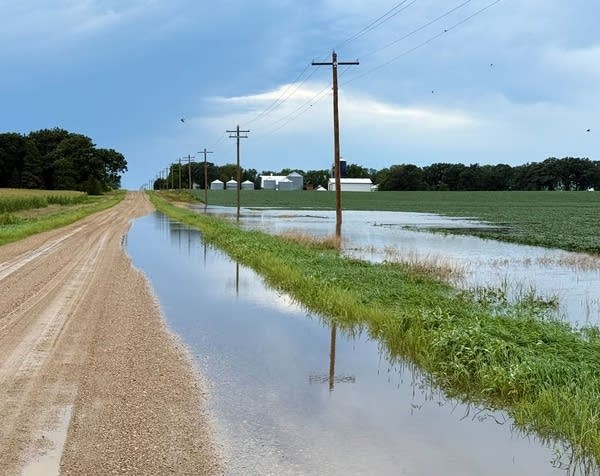
Variable weather has also led to increased rainfall in some parts of the region, which can lead to flooding. Waterlogged soils can mean farmers have fewer workable field days. It also disrupts soil conditions and nutrient efficiency, which is a problem in and of itself.
The region's landscape is varied. It’s got hills, depressions and uneven terrain overall. These differences can make it difficult to apply fertilizer, as a blanket application could lead to oversupply in some areas and undersupply in others.
“There are ways to continue to improve each year, and that's through a lot of the solutions we're seeing in precision agriculture, remote sensing, using drones and satellites to see what's happening in the field,” said Aderholdt
However, a lot of the technology surrounding these solutions can be complicated and requires skilled labor to operate. That skilled labor tends to be younger, and younger adults may not be too keen to move to rural areas.
“My assumption is that there is the perception that services or amenities aren't as prevalent in these communities,” said Aderholdt. “So there's this feeling of isolation from what you might have become accustomed to or want out of the community you live in.”
Emerging technologies and training can help address some of these issues, such as pest detection, which often relies on manual scouting. Some imaging technologies show research promise for crop disease identification, but high equipment costs are among the obstacles to their adoption.
Aderholdt said it's important that Grand Farm connects with companies that have solutions to the problems highlighted in the report, as it has research fields for testing.
“We have testing environments that match the real-world conditions, so that these companies can try something else out at a low cost and see if it works for our farmers,” said Aderholdt. “You also might not have enough product to apply on a farm because you're a really early-stage startup, and so we work a lot with really small test plots to make sure we can get these things moving.”
Collected from Minnesota Public Radio News. View original source here.
 Minnesota Public Radio (MPR) is a public radio network for the US state of Minnesota. With its three services, MPR News, YourClassical MPR and The Current, MPR operates a 46-station regional radio network in the upper Midwest.
Last updated from
Minnesota Public Radio (MPR) is a public radio network for the US state of Minnesota. With its three services, MPR News, YourClassical MPR and The Current, MPR operates a 46-station regional radio network in the upper Midwest.
Last updated from