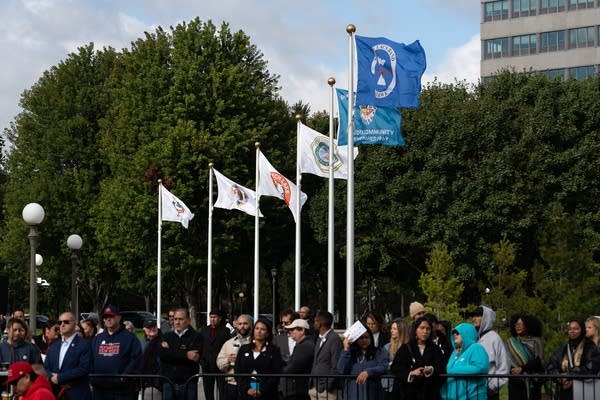
Minnesota marks Indigenous Peoples Day on Monday. While the word “Indigenous” is more common than ever, the word “Indian” and phrases like “Indian Country,” “tribe” and “band” turn up regularly in news stories about Native people.
It is language that can feel stuck in the past, even if policies have changed. These words and phrases appear in the U.S. Constitution, treaties and federal law, and they continue to shape Native political and cultural life.
Keith Secola, an elder Ojibwe musician who grew up on the Iron Range in northern Minnesota, was in Duluth in September to play a show at the American Indian Community Housing Organization.
Secola says he’d been thinking about how the word “Indian” was used when he wrote his trademark song, “NDN Kars,” some 40 years ago on a canoe trip in the late ‘70s. He says he set out to reclaim language.

“Indian would be derogatory, but it’s ours,” Secola said. “It belongs to us, doesn’t belong to the mainstream culture, and it’s ironic that we’re using English, the language of the colonizers, to empower us. There’s a big irony right there. We’re using it to liberate.”
His song has served as an anthem for Native people across the U.S. He spells it a little differently, writing N-D-N, to acknowledge how Native people have refashioned the word through their own pronunciation.
“I wanted to write something that would give our people pride,” Secola said.
The word “Indian” dates to Christopher Columbus's attempt to find a western route to Asia. It’s said when he landed on an island in the Bahamas, he thought he'd arrived in the Indies and called the people he met there Indians.

The word “Indian” and the phrase “Indian Country” are used widely in U.S. law, from Supreme Court decisions on treaty rights to child custody proceedings to a ruling over federal hiring practices.
In 1974, the U.S. Supreme Court ruled that “Indian” in federal law is not a racial category. The court said the word refers to citizens of federally recognized tribes and therefore refers to members of a political category. Courts have leaned on that distinction ever since.
Attorney Brandon Alkire says using those particular words and phrases holds the federal government to promises it made in treaties and legislation, in ways other general terms like “Native American” and “Indigenous” may not.
“Hundreds of federal laws that this is written into,” Alkire said. “So, it’s really baked into American jurisprudence.”
Alkire is a member of the Standing Rock Sioux Tribe in North Dakota. He’s also the legislative director for the Minnesota Indian Affairs Council and specializes in federal Indian law and policy.
“Indian Country is a jurisdictional term of art to explain something that’s not easily captured under just everyday definitions,” Alkire said. “It’s really to highlight this interaction between the federal government and tribal nations.”
Alkire traces that language to the 1830s and a set of U.S. Supreme Court decisions penned by Chief Justice John Marshall.
“Justice Marshall was not acting favorably for Native Americans,” Alkire said. “But he needed a way to marry these two competing governments in a way that people could comprehend and understand, but also in a way to show power over the tribal nation.”
Alkire says Native people have used those words anyway and changed what they mean. He points to “tribe,” a word written into federal and state law.
“We acknowledge it. We own it,” Alkire said. “It doesn’t change or diminish our sovereignty. It’s just one of those words that was given to us, and so we'll take it.”

Alkire says he’s asked about which words to use all the time. His answer is short, for those working with tribal nations and their members.
“Speak with them ahead of time for protocol,” Alkire said. “Ask them how they want to be referred to.”
Musician Keith Secola agrees.
“If you really want to respect, learn that tribal name,” Secola said. “That’s your locality, and when you say that to Native people, they’ll like that.”
Wearing a straw hat and sunglasses on stage in Duluth, Secola played the opening bars of the song that made him a household name in Native communities. He was joined by The Rangers, a band from northeastern Minnesota, along with his friend Gary Farmer, the actor and musician, and singer-songwriter Rosemary Berens.
Dedicated fans sang along with the pop anthem, word for word.
Collected from Minnesota Public Radio News. View original source here.
 Minnesota Public Radio (MPR) is a public radio network for the US state of Minnesota. With its three services, MPR News, YourClassical MPR and The Current, MPR operates a 46-station regional radio network in the upper Midwest.
Last updated from
Minnesota Public Radio (MPR) is a public radio network for the US state of Minnesota. With its three services, MPR News, YourClassical MPR and The Current, MPR operates a 46-station regional radio network in the upper Midwest.
Last updated from