Most members of the Detroit Lakes school board have been trying to effectively ban rainbow stickers from school grounds since July. But a district policy committee meeting earlier this week added yet another hurdle between them and the end of the rainbow.
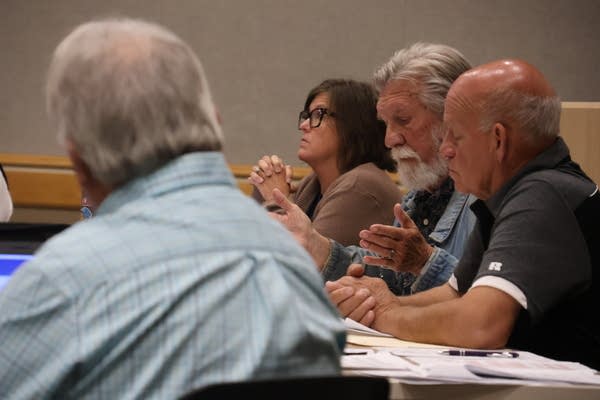
The committee is made up of school board members and administrators like school principals. It met Wednesday morning to discuss a policy that overhauls district rules regarding the “distribution of nonschool-sponsored materials.”
It ultimately decided to postpone any policy changes after administrators shared their concerns and confusion about how to enforce the proposed policy.
“We concluded to delay it,” school board member Michael Walther said. “We asked the teachers to actually give us some input of what their actual concerns were.”

The board’s earlier July ban was prompted by stickers that some teachers display to indicate their classroom is a safe space for LGBTQ+ students. That ban is the subject of a lawsuit filed by the American Civil Liberties Union of Minnesota and two students in the district who said it violated their constitutional rights.
Following the ACLU-MN’s lawsuit, the ban was revoked as the board introduced a general overhaul of the district’s Policy 505, which limits what teachers and students can display on campus. The policy had its first reading at last month’s board meeting.
The policy’s purpose, according to board member Sanford Nelson at an earlier work session, was to enact the earlier ban on rainbow stickers that some teachers display in their classrooms in a way that meets “legal muster.”

But at Wednesday's meeting, Superintendent Mark Jenson indicated that the district’s legal troubles wouldn’t be solved by that pivot. The district met with legal counsel in a closed-door special school board meeting last month to discuss the lawsuit.
“You have been advised by two lawyers now to not go down this road,” Jenson said earlier this week to board members who support the ban and the revised policy.
In earlier statements to MPR News, the ACLU-MN indicated they would continue to pursue legal action even if the board passed a policy that didn’t explicitly mention rainbow stickers.
“Our clients brought their lawsuit because it was clear from the language of the rainbow ban and school board member statements that the school board targeted rainbows based on anti-LGBTQ+ bias and a desire to eliminate expression of LGBTQ+ support and identity,” the ACLU-MN said in a statement. “The rainbow ban has already chilled LGBTQ+ speech and harmed our clients.”
Principals push back on proposed policy
Later in the meeting, school administrators weighed in with practical concerns about the policy’s implementation. For instance, Rossman Elementary Principal Emily Sternberg asked whether the policy, which limits which flags can be flown, would prohibit Gay-Straight Alliance clubs from displaying rainbows.
“That's an approved club,” she said. “That's a group of students that's allowed to meet, so they should be able to, in my interpretation of [the proposed policy], display material that is associated with that club.”
The policy also bans flags that promote or endorse an "ideological" viewpoint, which Sternberg said is a word that means different things to different people.

“For example, a lot of people do not consider anything that has to do with stickers ideological at all,” she said at the meeting. “Rather, it's about human rights. It's a symbol of safety. It's a cue. It's a visibility component for a marginalized group, and that is not categorically ideological.”
Board member Michael Walther then proposed delaying consideration of the policy until more input could be heard from administrators.
“I think Emily (Sternberg) has brought out some really good questions. The stuff that I’ve received, other input, has not been,” he said.
“Rather than hashing over what has been done right or wrong, I would suggest, why don’t we just table this?” he added.
Surprise ban burned trust among board members
Board member Julie Smith-Yliniemi, who opposes the ban, said she hopes this marks a break in this saga. But she’s not sure that it will.
At multiple recent board meetings, including the one in July that originally introduced the ban, she was caught by surprise by last-minute motions made by board member Sanford Nelson and said that could happen again.
“Is that a possibility? Absolutely,” she said. “Am I holding on to hope that that isn't the case, and you move forward with the recommendation of pulling it from the agenda? I hope that does stay.”
Nelson did not respond to MPR’s request for comment.
The board’s next meeting is set for Oct. 26. Smith-Yliniemi said the agenda will include a proposed policy change that asks board members to attempt to notify other board members at least 24 hours in advance before adding an item to the agenda.

Part of the ACLU-MN’s lawsuit alleges that four board members, including Nelson and Walther, broke the Minnesota Open Meeting Law by discussing the rainbow ban privately before introducing it at the July board meeting.
Smith-Yliniemi said the lack of transparency and discussion has altered the board members’ relationships with each other.
“Do I think that the majority of the board is well-intended? Yes,” she said. “Do I think that some of the board members have a hard time looking at the full picture of things and taking in data and research and doing things in a good way that includes our community and our administrators? Yeah, they have a difficult time with that.”
The board’s makeup may soon look different following the Nov. 3 election. Three board seats are on the ballot and two incumbents are running to keep their seats.
“I do hope whoever is on the board and starting their term … that we can really start from scratch, start over and how we are going to build that trust,” Smith-Yliniemi said. “And that trust starts with no surprises like we've been given in July, August and September.”
Collected from Minnesota Public Radio News. View original source here.
 Minnesota Public Radio (MPR) is a public radio network for the US state of Minnesota. With its three services, MPR News, YourClassical MPR and The Current, MPR operates a 46-station regional radio network in the upper Midwest.
Last updated from
Minnesota Public Radio (MPR) is a public radio network for the US state of Minnesota. With its three services, MPR News, YourClassical MPR and The Current, MPR operates a 46-station regional radio network in the upper Midwest.
Last updated from