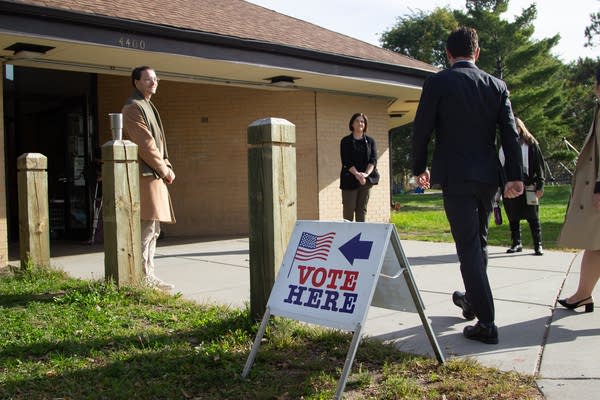
There are three contested judicial races in Minnesota on the ballot this election – which is uncommon. Here's what districts those races are in, why there are only three contested races and what qualifications these candidates need to meet.
Why is it uncommon for judicial seats to be contested?
Contested races for judicial seats tend to be uncommon in Minnesota, as most come about due to a judge’s retirement.
“They typically hold those seats until they decide to retire or reach [the] retirement age of 70,” Peter Knapp, professor at Michell Hamline School of Law, said. “That’s required by Minnesota law.”
Minnesota state aw, Section 480A.02 Subdivisions 2 and 4, states that each judge must be elected during a general (or statewide) election to serve a six-year term, whether they hold at-large or congressional district seats.
Vacancies that occur before a six-year term ends usually require the acting governor to appoint a replacement judge for that seat.
There are instances where judges decide to retire but will not end their term prior to an Election Day, such as Judge Greg Galler from the 10th Judicial District.
“It’s not as if this hasn’t happened before. From time to time, judges decide to do that, and that’s a contested race that drew a couple of potential candidates,” Knapp said.
How many contested judicial races are on the ballot this November?
For this election cycle, there are a total of three contested judicial races happening in Minnesota. That’s out of 122 judicial races. These contested races are happening in the 5th, 9th and 10th Judicial Districts.
-
The 5th Judicial District consists of 15 counties in southwest Minnesota. Its candidates are incumbent judge Christina M. Wietzema being contested by Christopher Cain.
-
The 9th Judicial District consists of 17 counties in northwestern Minnesota. Its candidates are incumbent judge Matthew R. Mallie being contested by Henry C. Ambelang.
The 10th Judicial District consists of eight counties in the northeast Twin Cities metro area. Its candidates are incumbent judge Greg Galler being contested by Ben Lacy and Rebecca A. Waxse.
What requirements do judicial candidates need?
According to the Minnesota Secretary of State’s website, candidates for state judicial offices must:
-
Be eligible to vote in Minnesota.
-
Have not filed for another office at the upcoming primary or general election.
-
Be at least 21 years old upon assuming office.
-
Be a resident of Minnesota for at least one year before the general election.
-
Be licensed to practice law in Minnesota.
“That doesn’t necessarily mean you have to pass the Minnesota bar… It’s possible to pass bar in another state and become licensed in Minnesota,” Knapp said.
You can find who your Judicial District Judges are here.
Collected from Minnesota Public Radio News. View original source here.
 Minnesota Public Radio (MPR) is a public radio network for the US state of Minnesota. With its three services, MPR News, YourClassical MPR and The Current, MPR operates a 46-station regional radio network in the upper Midwest.
Last updated from