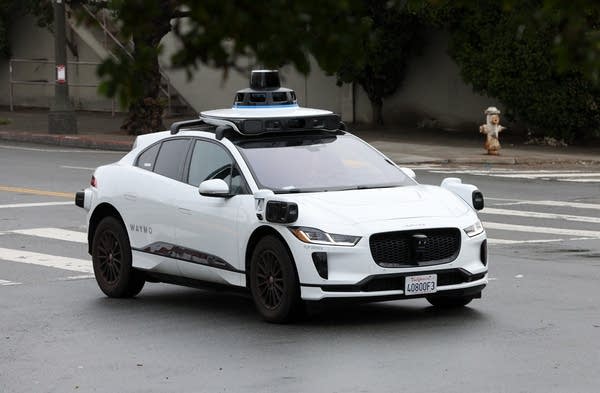
The Minneapolis City Council is set to vote Thursday on a proposed ordinance that would require human monitors in driverless rideshare vehicles.
The measure appears headed for passage after it advanced from the council’s Committee of the Whole on a 7-4 vote Tuesday, with two council members absent. However, the ordinance could be vetoed by Mayor Jacob Frey, who has been critical of the measure.
The robotaxi industry is booming nationwide, and the most widely known driverless rideshare vehicle operator — Waymo — has already been testing its fleet in the Twin Cities.
Supporters of autonomous vehicles say welcoming the industry in Minnesota would boost the economy, provide greater consumer choice, increase safety and prevent drivers from discriminating against disabled riders. Critics see the emerging industry as the latest Big Tech attack on labor — and worry driverless cars actually introduce new safety, public nuisance and privacy concerns.
At the Minnesota Capitol this spring there was bipartisan agreement that statewide regulation was needed, but disagreement about the safety of the vehicles and their impact on the local economy ultimately tanked efforts to pass legislation. That has left cities in the lurch to deal with driverless cars themselves, but it’s unclear if local governments have the legal authority to do so.
Progressives on the Minneapolis City Council have championed the ordinance now up for a final vote, which would require human safety monitors in autonomous vehicles. Skeptics of that proposal have scoffed at the concept of drivers in driverless cars — but advocates argue without that requirement, thousands of rideshare drivers could be put out of work.
“Automation has a demonstrated track record of leading to job displacement,” council member Robin Wonsley said Tuesday. “I would hope we all want to make sure workers are not displaced as a result of us making sure we’re making technological strides in our city.”
The ordinance would also require that the human safety monitor have a driver’s license and that the monitor be paid minimum wage. Supporters also argue the measure gives the city more time to study the issue of autonomous vehicles because — if passed — the ordinance wouldn’t go into effect until October 2027.
A spokesperson for Frey said he considers the ordinance “a back door ban, and a bait for the state to come in and pre-empt us.” Frey has pushed for the state to take the lead on autonomous vehicle regulation instead.
Based on Tuesday’s committee vote, ordinance advocates could be hard-pressed to muster the nine votes needed to override a mayoral veto.
While Waymo continues test-driving its fleet in the Twin Cities — with humans behind the wheel, and not yet taking customers — it’s not clear when the company might launch its rideshare service here.
A spokesperson for Waymo previously said that the proposed Minneapolis ordinance goes too far, and would limit the company’s ability to operate in the city.
Collected from Minnesota Public Radio News. View original source here.
 Minnesota Public Radio (MPR) is a public radio network for the US state of Minnesota. With its three services, MPR News, YourClassical MPR and The Current, MPR operates a 46-station regional radio network in the upper Midwest.
Last updated from
Minnesota Public Radio (MPR) is a public radio network for the US state of Minnesota. With its three services, MPR News, YourClassical MPR and The Current, MPR operates a 46-station regional radio network in the upper Midwest.
Last updated from