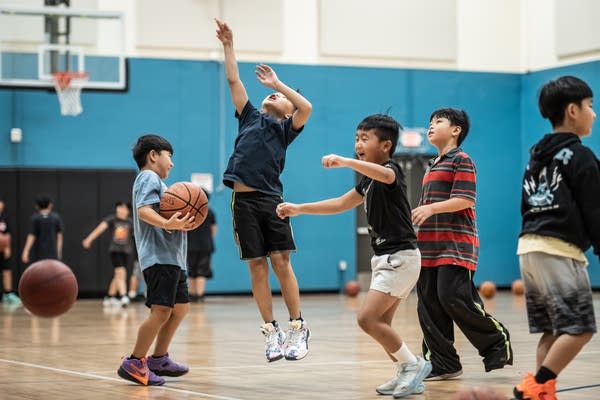
Coach Myles Moore towers over nearly two dozen eager 8- to 12-year-olds as he talks through the next drill and attempts a basket.
It’s their first time together after a few weeks off and the athletes have drilled everything: dribbling, shooting and footwork. The practice is led by Alex Born, a teacher and coach of the basketball program at Community School of Excellence, a pre-K-12 Hmong language and culture school.
Moore and Born are the coaches of the junior varsity and varsity girls and boys basketball teams, both in just their second years.
They’re doing it at a time when the WNBA is more accessible than ever. Media deals established over the past few years have created more avenues, especially for young people, to see high-profile Lynx players such as Napheesa Collier, Courtney Williams and Olivia Miles — the latter who rocketed to stardom on the back of a stellar rookie campaign and has become a role model to many youth players for her relatable off-court demeanor.
It’s made the past months preparing for his team’s season so exciting for Moore. After the WNBA draft last spring, there were already whispers among his athletes about the rookie point guard before she even hit the court.
“They started seeing her play, then everyone just started raving about her, just sending me clips, videos,” he said.
The way the highlight reels have inspired his athletes does half his job for him, he joked.
“You're sending me that, knowing that you can do that,” he said. “So let's go out and maybe try and do it.”


Basketball has been in Moore’s life since he was young, before an ACL tear turned him off playing and on to coaching. A decade later, he still looks for new ways to offer basketball to more students.
“I started coaching just off of the love of the game and passing it down to the younger generation,” Moore said. “I feel like when I pour into a student or athlete, it fills my bucket just as much as it fills theirs, and I just enjoy doing it. I enjoy being in kids' lives each and every day, and just being a positive leader and a positive role model.”
As a long-time Lynx and Timberwolves fan, he’s immersed in the teams’ updates and shares the reel-worthy moments. But not all his players are.
Working with an athletic program so new, he’s had the opportunity to find unique ways to connect to children who may have never been exposed to basketball before. He lets the hype reverberating off women’s basketball fuel both his drills and his own excitement for coaching the next generation.
“When I’m with them, we all have one interest: the interest is basketball,” Moore said. “I just like to bring something new to people. They’re interested in it, I love it, so that’s a meeting level right there for me with them.”
The Rec Specs
While the accolades poured in for Miles on the court throughout the season, off the court, she was inspiring both young athletes and the broader community, becoming something of a cultural phenom. Her No. 5 jersey became a mainstay at Target Center. Silhouettes of her signature afro and Rec Specs — protective goggles designed for athletes with prescription lenses — are prominent on t-shirts and yard signs.
The Lynx even hosted a goggle giveaway in honor of the rookie. Thousands of fans donned similar specs as Miles for the game.
But it’s Miles’ unapologetic attitude about her unique persona that has captivated fans both young and old.
“As a kid, you get the jokes and the getting made fun of for wearing glasses,” Miles said in a postseason interview. “And I obviously wear glasses all the time, and so it's like, there's no context. This is it. If you take them, I can't see.”
But something as small as giving a kid with glasses confidence that they, too, could become the WNBA Rookie of the Year, is a challenge Miles said she is more than willing to shoulder.
“If I can keep kids in sports as long as possible, it's really inspiring,” Miles said. “And especially if they need glasses to do it, I hope I can be a role model for them that way.”

Earlier this summer, while working with youth community teams, Moore noticed a player wearing Rec Specs.
“I was like, ‘Oh, you're doing it just like Olivia Miles,’” Moore recalled. “He looked at me with a very nice grin and was happy.”
Moore didn’t anticipate the 13-year-old would know the Lynx guard, but the conversation quickly turned to the Lynx’s squad and predictions for the season.
Getting to see themselves
Seeing stars like Miles changes the futures young people see for themselves, according to Nicole LaVoi, director of the University of Minnesota’s Tucker Center for Research on Girls and Women in Sport. It’s especially important for children to see themselves in the stars they admire.
“When you have an individual like Olivia Miles, who has her own look, her own brand, her own style that is outside the typical norm for all those kids that don't fall in that typical norm, which is most of them, it's a really refreshing role model for them,” LaVoi said. “You know, she's got glasses. She wears her hair the way she wants, naturally, unapologetically, and she just is herself.”
Women athletes make up around 43-45 percent of the population of athletes, but media coverage typically shows only 2-5 percent, LaVoi said. Streaming options close that gap to closer to 10 percent, but LaVoi said if it is harder to find coverage, it’s harder to become a fan.

Moore has noticed the same interest in Miles in his youngest athletes, such as 9-year-old Ariana Inthasone, who began playing a month ago.
She joined basketball to follow in her dad’s footsteps. Her mom had to set ground rules on when Ariana can shoot and dribble around the house, especially when her dad puts the WNBA on.
“I usually just watch it, and then sometimes I grab my basketball and I sometimes play with it,” Ariana said. “I was copying the movements of the basketball team, and I acted like I scored, but I scored it on the couch.”
Ariana’s allowed to go practice outside while it’s warm enough if her homework is completed. She stretches while her mom checks it.
All access
As more investment and sponsorships go to women's sport leagues, they’re more accessible to fans like Ariana. But that access also comes at a time when the $40 billion youth sports industry ecosystem is becoming less accessible.
“Data in the youth sport industry paints a very grim picture because youth sport has become and increasingly is becoming a pay-to-play model,” LaVoi said.
LaVoi said the access gap contributes to children feeling like they don’t belong. An antidote is coaches who invest in their players both on and off the court, encouraging self-mastery, support and positive attitudes.
Lynx head coach Cheryl Reeve has long been a proponent of that model, molding the likes of legends like Maya Moore, Lindsay Whalen and, now, Miles.
“Now, as that baton got passed, all that hard work was done, and now the exposure is there,” Reeve said. “For them, what I need from the Olivia Miles era, is to not forget where we came from, and the work and the pouring into communities to continue the identification and never be above it.”
Ariana knows the stars she plays along with in the living room put in extra hours, but she finds something especially affirming about Miles’ game.

“When I watch her, I feel like she sometimes scores, but sometimes doesn't,” Ariana said. “That makes me feel like it's me. Cause, like, I'm a little good at basketball, and like I'm not that good too.”
For Moore, Miles’ emerging popularity is a godsend. He sees his role, especially in a space able to offer youth sports after being nonexistent, as being a “stepping stool” for his athletes.
“One of the best gifts to know and to then to realize that there's a child or a kid who just doesn't have the energy or the will to even want to wake up and come to school, but to know that they have basketball practice at the end of the day and they get to see me,” Moore said. “I'm just so grateful for that.”
Collected from Minnesota Public Radio News. View original source here.
 Minnesota Public Radio (MPR) is a public radio network for the US state of Minnesota. With its three services, MPR News, YourClassical MPR and The Current, MPR operates a 46-station regional radio network in the upper Midwest.
Last updated from
Minnesota Public Radio (MPR) is a public radio network for the US state of Minnesota. With its three services, MPR News, YourClassical MPR and The Current, MPR operates a 46-station regional radio network in the upper Midwest.
Last updated from