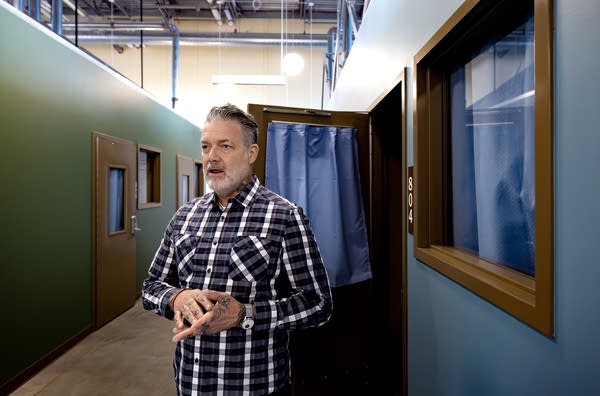
When visitors walk into Avivo Village Central Minnesota, they’re greeted by open space, high ceilings and lots of natural light.
The walls are muted shades of yellow, green, blue and orange. It’s bright but calming. And thanks to sound-deadening construction features, the spacious building is actually quiet.
"We want to create a space that is able to not overwhelm people,” said John Tribbett, service area director for the Minnesota nonprofit Avivo, which built and operates the facility. “A cacophony of sound that can sometimes take place in smaller spaces can be overwhelming to people."
Avivo opened its newest shelter for people experiencing homelessness in St. Cloud earlier this month. The nonprofit has operated a similar but larger facility in Minneapolis’ North Loop neighborhood for about six years.

People sometimes avoid going to homeless shelters because they don't feel safe there, or they don't want to be separated from their pets, partners or belongings.
Traditional homeless shelters are often crowded, somewhat chaotic and can feel unsafe, with people sleeping close to one another on cots or mats.

"I don't know a lot of people in my life that would feel real comfortable walking into a large space and spending the night — literally in some cases — just a few feet from a stranger,” Tribbett said. “And that stranger may have had a really bad day, and they might have some real intense mental health issues.”
“It's hard for people to be successful in spaces where they're challenged by their environment," Tribbett added.
Avivo is changing the traditional shelter model to support those experiencing chronic homelessness and giving people their own space to make a new start. Its philosophy is that a trauma-informed building design and its aesthetics can go a long way toward helping or hindering a person’s success, Tribbett said.
Avivo’s St. Cloud shelter has 48 private, bedroom-sized dwelling units that provide privacy, security and solitude, which Tribbett calls basic human needs.
At Avivo, couples stay in separate units but can spend time together. Pets are welcome; there’s even a dog-washing station. And the individual units have locking doors, allowing people to keep their possessions secure.

The shelter has spaces where guests can shower and do laundry. And there are conference rooms and common spaces where they can meet with a healthcare provider, attend group therapy or even do an art project.
“When people are outside, they're in survival mode. They're in their brainstem. They're in that reactive space,” Tribbett said. Avivo aims to create spaces “where people can get into their frontal cortex a little bit more and can begin to think a little bit more purposefully, not just the day-to-day survival,” he said.
Everyone staying at Avivo has a case manager to connect them to the support services they need, whether that’s counseling, mental health and addiction treatment, education or job training, and help in finding permanent housing.
There's no limit on how long people can stay, he said, as long as they're moving in a positive direction, Tribbett said.
“We want people to feel at home, but this is not their long-term home,” Tribbett said. “This is a place for them to feel safe long enough to move into something else.”
From ‘a really dark place’ to helping others
James Aloysuis Flores II-Demo was living in a tent in Minneapolis a few years ago when an outreach worker suggested Avivo Village. Initially, he rejected the idea of accepting help for his opioid addiction and other struggles.
“I was just so stuck in a really dark place at the time,” Flores-Demo said.
He tried staying at the Minneapolis shelter but said he ended up getting arrested. After spending time in jail and a treatment facility, Flores-Demo returned to Avivo in 2021 and stayed two and a half years.
“It was really helpful being able to be there,” he said. “People that were even using, they were very respectful of my sobriety. The staff was always uplifting me, like ‘Hey, you’re doing a good job. Keep at it.’”

Flores-Demo said he’d previously stayed at traditional homeless shelters, but he found them too open and crowded. And while he was living outside, he said his possessions often disappeared.
“To be able to have a spot to call my own for the moment, it really did help a lot because I didn't have to worry about things and look over my back,” he said. “I had a safe spot to sleep.”
While at Avivo, Flores-Demo got a job, saved money and bought a car. He’s now been in recovery for five years and has his own apartment. He works as a peer support specialist for the Hennepin County Health Care for the Homeless program.
“It’s really empowering to know that I’m able to … provide resources and services to people that were in the same spot that I was in,” he said.
Homelessness on the rise
St. Cloud, like other cities across Minnesota and the U.S., has seen an increase in homelessness in recent years due to soaring housing costs and more people experiencing physical health problems or mental health and substance use disorders.
Julie Ellis, director of adult and disability services for Stearns County, said there's a shortage of space in local homeless shelters.
"They will fill up even more as the weather gets colder, because some people will actually tent throughout the summer by choice,” Ellis said. “But when it gets as frigid cold as we have in Minnesota, it just isn't safe for people to do that — although they try."

Avivo is a low-barrier shelter, meaning it doesn’t require sobriety and people who stay there may be actively using substances. Avivo says it conducts regular safety checks and helps connect people to treatment when they’re ready.
Jennifer Salsness-Tvedten, who supervises Stearns County’s homeless outreach workers, said increased substance use coupled with mental health issues is a huge factor in the rise in homelessness. She said it’s also a reason why people sometimes stay away from traditional shelters.
“This will give them a safe place to sleep, and they can start to think about recovery while they’re there,” she said.
Collected from Minnesota Public Radio News. View original source here.
 Minnesota Public Radio (MPR) is a public radio network for the US state of Minnesota. With its three services, MPR News, YourClassical MPR and The Current, MPR operates a 46-station regional radio network in the upper Midwest.
Last updated from