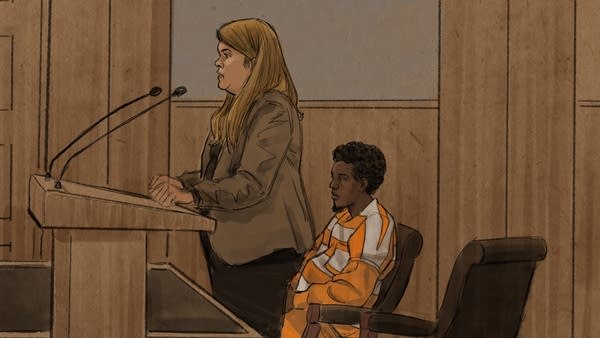
U.S. District Judge Nancy Brasel on Wednesday sentenced Salim Said, the co-owner of the former Safari Restaurant in Minneapolis and a major player in the Feeding Our Future fraud scheme, to 30 years in federal prison.
“You took more than taxpayer money to enrich yourself,” Brasel told Said. “You took the reputation of our state down with you. It’s my hope that one day the words ‘Minnesota’ and ‘fraud’ won’t be spoken in the same sentence, but I fear that day is a long way off.”
In 2025, a jury convicted Said, 37, on all 21 counts including wire fraud, bribery and money laundering.

The same jury also convicted Aimee Bock, 46, of leading a scheme to steal several hundred million dollars from taxpayer-funded child nutrition programs by filing fraudulent reimbursement claims replete with phony invoices, falsified meal count forms, and rosters listing the names of fictional children. In May, Brasel sentenced Bock to nearly 42 years in prison.
Said received the third-longest prison term of the 32 people sentenced so far. Only Bock and Abdiaziz Farah, who was convicted at an earlier trial in 2024 and later pleaded guilty to trying to bribe a juror, received longer total terms. They are among 81 defendants charged in the sprawling case since 2022.
“My client, at no point was he in the position of Ms. Bock,” defense attorney Barry Zone said. “Not even close. Ms. Bock signed every check. Ms. Bock was the gatekeeper of all the money.”
Zone noted that in an earlier job as a prosecutor in New York, decades-long sentences were typically reserved for people convicted of violent crimes including murder. He also pointed to Said’s traumatic childhood in Somalia, where he was “verbally, physically, and sexually abused,” and was once left tied to a tree in an isolated area with wild animals.
Assistant U.S. Attorney Rebecca Kline countered that Safari Restaurant on Lake Street, of which Said was a co-owner, stood “alone at the top of the mountain” of fraud proceed recipients after Said siphoned $13 million from taxpayers.
“This defendant has never taken responsibility,” Kline said. “He sat in that witness box and lied over and over and over, minimized, deflected. [He] said things that were plainly untrue over and over again.”
Prosecutors said that Said and other defendants connected to Safari stole $44 million from the federal programs.
Kline added that at the height of the scheme, Said personally submitted 6,000 phony meal claims for Safari and paid bribes to Bock and Feeding Our Future employee Abdikerm Eidleh, who was arrested in Somalia in June and returned to the U.S.
Jurors found that Said used the $310,000 purchase from Bock of a non-functioning childcare center in Burnsville to disguise a kickback payment to her.
“Why bribe the ringleader if you don’t benefit from doing so?” Kline asked.
Reading from a brief prepared statement, Said apologized for his crimes.

“I’m deeply sorry for the actions and my involvement in this very serious case,” Said said. “And I know better. And I’m so sorry to the people I hurt. You’ll never see me again in this or any other courtroom on the wrong side of the law.”
Brasel acknowledged Said’s “absolutely tragic personal history” but said that she had a hard time “connecting your background with the greed that drove the fraud.”
The judge noted that unlike other fraud defendants, Said had a good job at a restaurant and was “not in a financial tough spot.”
“When this opportunity was presented to you, you took it and ran away with it,” Brasel said, also noting that Said made “defrauding the public a scalable business model.”
“At a time in our history when it seems everyone was seeking to help, you not only stole from the taxpayers, you did it while pretending you were helping,” Brasel said.
She added that because Said is a legal permanent U.S. resident, he could face deportation. His sentence also requires that he spend three years on supervised release after leaving prison.
Brasel previously ordered Said to forfeit $7.8 million as well as a 2021 Chevrolet pickup truck, a 2021 Mercedes Benz, real estate in Minneapolis and Plymouth and a commercial building that he purchased in Columbus, Ohio that was the former home of a cooking school.
Collected from Minnesota Public Radio News. View original source here.
 Minnesota Public Radio (MPR) is a public radio network for the US state of Minnesota. With its three services, MPR News, YourClassical MPR and The Current, MPR operates a 46-station regional radio network in the upper Midwest.
Last updated from