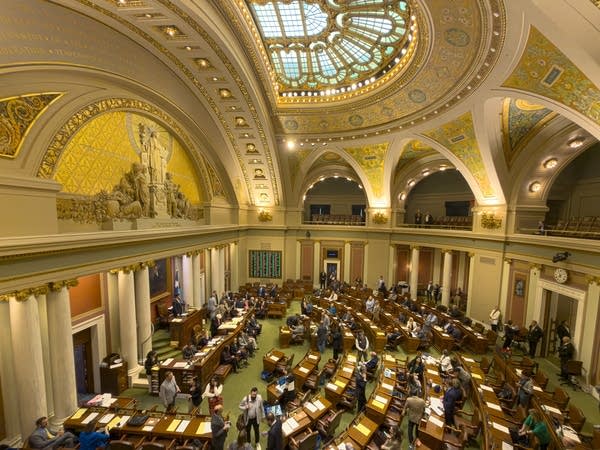
Control of the narrowly split Minnesota Legislature and the governor’s residence is on the ballot this fall, with both parties telling voters they’re best suited to hold power in this moment.
Republicans court voters with a pitch for change, saying a reset is needed after two decades of DFL control in the governor’s office and massive fraud uncovered in state government programs. Democrats, meanwhile, argue voters should send them to St. Paul with legislative majorities to lower costs and to safeguard the state against some of the Trump administration’s policies.
The parties agree that some policies are worth another look in 2027. Among them are preventing government fraud and waste and bringing down prices for consumers seeing costs surge for gas, groceries, housing and healthcare.
But they split on some of their approaches.
MPR News spoke with the legislative leaders about their top priorities should they gain Capitol control. Here’s a look at what their parties would take on first if they start 2027 with all three levers of state government power.
Bringing down costs
Both Democrats and Republicans agree that state lawmakers have a role to play in bringing down costs. But they don’t see eye-to-eye on the way to do that.
Republicans point to state spending that has grown in recent budget cycles, particularly under the 2023-24 DFL trifecta at the Capitol. They say lawmakers should look for areas to cut and pass on potential savings to taxpayers, like cutting car registration tab fees and lowering the state’s tax rates. They want to reexamine programs and services to see whether they’re working as intended.

“Minnesota state government desperately needs a reset,” said House GOP Caucus Leader Harry Niska of Ramsey, calling the current budget trajectory “unsustainable.”
“We need economic growth. We need energy abundance. We need education that's focused on educational outcomes,” Niska continued. “And I think all those things are things that are giving Republicans a chance to course correct our state.”
Free school meals, paid family and medical leave and earned sick and safe time for workers are among the programs pushed forward by Democrats that could fall into that category. Lisa Demuth, the Republican nominee for governor, has said GOP leaders would likely look to rein in those programs, rather than abandon them altogether.
She and other Republicans have suggested cutting education requirements approved under the last DFL trifecta and loosening or removing others that aren’t working. Republicans also propose further efforts to find and prosecute fraud in state government programs to recoup some of that money.

Democrats say they hope to keep in place programs implemented in 2023 and 2024. They’re considering other ways to lower the cost of healthcare, child care, housing and groceries. They point to tariffs imposed by President Donald Trump and the war in Iran that have caused inflation and higher fuel prices. They also worry about reduced federal support for programs that provide assistance to people in need and reimburse hospitals for care.
They say they want to go after some of the practices that can hike prices.
“We want to ban surveillance pricing, go after price gouging. You know, really just do everything we can to address this affordability crisis that middle class and working people are facing in Minnesota,” said House DFL Caucus Leader Zack Stephenson of Coon Rapids, adding that affordability is Democrats’ top priority.
DFLers propose establishing universal primary healthcare access, closing what they call corporate tax loopholes and prohibiting private equity companies from buying up homes. Those are among proposals in their 2027 policy agenda.
Sen. Nick Frentz, DFL-North Mankato, is running the Senate DFL’s campaign. He agreed the state needs a reboot. But he said Democrats’ nominee for governor, Amy Klobuchar, is best poised to usher that in.
“I think Senator Klobuchar offers a unique opportunity for the state to reset and chart a new path forward,” Frentz said. “In particular, we need balance to appeal to the largest number of Minnesotans and to serve the needs that they have: transportation, education, health and human services.”
Fraud response and accountability
Fraud and the response by Gov. Tim Walz’s administration is the central campaign issue for Republicans. They say under a GOP trifecta, they’d hold people who were involved in the administration accountable.
Demuth and GOP leaders have said they’d fire commissioners or assistant commissioners who oversaw departments or agencies that became targets for fraud and abuse of state programs. That’s a natural changeover that could happen in any new administration, though.
“We have to make sure the processes that allowed the fraud to run unchecked are updated, and so the likelihood of that happening again is reduced to zero,” Senate Minority Leader Mark Johnson, R-East Grand Forks, said.

They also propose to make it easier to prosecute those who defraud government programs, heighten accountability measures for state officials who oversee the programs and change the culture of state government to focus on outcomes for state spending.
“What we are seeing and hearing is the fact that fraud has exploded, and it is harder to afford things here in the state of Minnesota because of state level leaders that have disrespected Minnesotans. Fraud is going to be top of mind,” Demuth said.
Lawmakers over the last two years have taken steps to make it easier for the state to stop payments to providers they suspect of fraud. A new watchdog agency over state government – the Office of the Inspector General – is set to be up and running next year.
Democrats agree that anti-fraud measures should be revisited in 2027. As part of her campaign, Klobuchar has said she’ll initiate an audit of state government on her first day. Legislative Democrats are in harmony.
“We want to take more aggressive action at it when we are returned in the majority, because every single dollar of fraud is unacceptable to us,” Stephenson said. “It’s $1 that’s a taxpayer dollar, but it’s also $1 that was supposed to be going to kids with autism, or a senior with disabilities, or a homeless person and who the hell steals from kids with autism.”

Responding to Trump administration
Democrats say that if they get a trifecta, they’d use it to buffer the state against some of the financial hits from the Trump administration. That includes moves to withhold payments for Medicaid programs. And they would seek to add new restrictions on federal law enforcement officers operating within Minnesota.
Following the federal immigration enforcement action in Minnesota, Democrats sought to ban agents from schools, churches and hospitals, among other places. They also tried to bar them from wearing face masks. They pushed unsuccessfully to make officers civilly liable if they shoot someone and fail to provide medical aid.
Stephenson said responding to the Trump administration’s policies and creating state guardrails would be a key focus for Democrats.
“We have a president who is hellbent on getting retribution against our state, and I don't think that's going to stop even after Election Day,” Stephenson said.
“Who can actually stand up and deliver to make their healthcare more affordable and protect their healthcare from the attacks of the Trump administration? Who can stand up to the Trump administration generally and their abusive policies towards Minnesota? I think the answer to that's pretty clear.”
Republicans said they’d be more willing to work with the Trump administration on fraud-prevention investigations and other efforts than the Walz administration has been.
“I'm looking forward to working with whatever administration is there. Because when we deliver for the people of Minnesota, Minnesota wins,” Demuth said. “And that is my intent.”
The new governor and Legislature assume those roles in January. The next legislative session begins Jan. 12.
Collected from Minnesota Public Radio News. View original source here.
 Minnesota Public Radio (MPR) is a public radio network for the US state of Minnesota. With its three services, MPR News, YourClassical MPR and The Current, MPR operates a 46-station regional radio network in the upper Midwest.
Last updated from
Minnesota Public Radio (MPR) is a public radio network for the US state of Minnesota. With its three services, MPR News, YourClassical MPR and The Current, MPR operates a 46-station regional radio network in the upper Midwest.
Last updated from