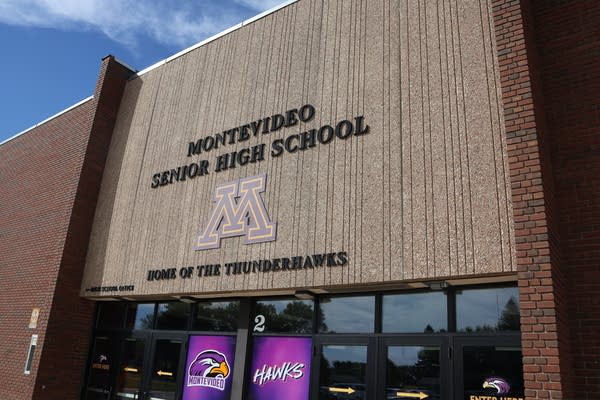
When it’s time for hands-on experiments in Montevideo High School senior Quinn Duellman’s science class, he and his classmates can’t light the Bunsen burners.
“We are unable to be using flames because the gas pipes are so bad that we're afraid of a gas leak,” Duellman told MPR News.
And the 17-year old says he tries to avoid using the restroom in his school because his friends “say that they’ve smelled a weird smell within the bathrooms.”
Montevideo Schools Superintendent Jamie Skjeveland acknowledges that the aging school’s restrooms smell pretty bad, and there’s a reason for that.
“The pipes that the sewage was going down, they were calcifying,” Skjeveland said. “It had calcified to the point where it was about the diameter of a straw.”

As a result, Skjeveland told MPR News that the sewage backs up.
“Whenever a toilet or urinal was flushed in our high school, we actually had the drainage from the urinal, it was kind of back flushing,” Skjeveland said. “It was coming back out. It was going [in] a direction that it was not supposed to go.”
The public schools in Montevedio are really showing their age. The elementary and middle schools were built in the mid-1950s and are approaching 75 years old. And the high school was constructed around the mid-1960s.
The science classrooms are badly out of date with some equipment that no longer is safe to use, and the outdated buildings sorely need enhanced security features for student safety in the modern age. And none of the schools had an assembly hall or auditorium space, so they’d rent the local movie theater or use the gymnasium for band concerts, school plays and other performances.
For years, school district officials, teachers, parents and the school board tried to convince the rest of the town’s voters to approve a referendum that would allow the district to raise the money needed to make the essential building repairs, improvements and upgrades.

The district went to Montevideo voters three times, and the tax hike measures failed each time.
Earlier this year, Skjeveland was only a few months into his new role as superintendent, but he said he and the school board needed to try one more time — and they needed to change their approach.
They decided to fan out into the small town of about 5,300 residents and meet with voters — their neighbors — face to face. Skjeveland said they held between 30 to 40 coffee talks to discuss the need for building improvements. And they decided to use a tried and true school activity and do a little show-and-tell to demonstrate the plumbing problems in particular.
“We were able to bring actual pipes, the calcified pipes,” he said. “We brought the actual pipes to these meetings. We had several community meetings. We met at bars. We met at churches. … wherever the people were is where our school board went.”
In February, Montevideo voters finally approved a $42 million bond referendum, with 57 percent voting yes and 43 percent voting no.

Wes Duellman, 53, who is Quinn’s dad and had two older kids who went through Montevideo’s schools, supported the referendum. He said he could understand why some voters weren’t too keen on raising their own taxes.
“Property taxes are high in a lot of small town communities and asking people to put another tax or having their property tax increase because of a school referendum didn’t sound appealing,” Duellman said. “Just for the fact that you know your people are [living] on [tight] budgets and having that go up.”
But Duellman said the more he talked with friends and neighbors, and provided them with information about the dire need for school building improvements, the more folks began to see the bigger picture. And part of what convinced them was seeing that even if they vote no now, taxes will eventually go up.

“It was really more about the investment, and long term too, that if you would rather have the cost of taxes go up because people are moving out of the area and the tax base is less?” Duellman said. “Or, do you want to invest in the community and pay more? You’re going to pay more either way, but pay more because you’re investing in students.”
Future of funding schools
Superintendent Skjeveland said a lot has changed in how school projects are funded since he first started working in education decades ago. He can understand why voters might be on the fence.
“I’ve watched in the course of my career how the expenditures in schools have outpaced the revenue coming in for decades,” he said. “The system of reliance on property tax, the way we fund schools, it’s broken, and we have created a system now where schools, just to survive, need to go out and rely on their local taxpayers.”

It’s a vicious cycle, Skjeveland said, as higher property taxes and the taxpayers’ ability to pay them become more of a burden, and that’s something he’s seeing all over Minnesota.
“People support public education,” he said. “What people don’t support is that they’re being taxed. Many times in many cases, right out of their homes.”
This is a challenge that many school districts are currently facing, and it’s a common sentiment that Kirk Schneidawind, executive director of the Minnesota School Boards Association, said he hears from all over the state.
“I just think we’re really in uncertain economic times,” Schneidawind said. “And I think the economic pressures, whether it’s building costs or the lack of state aid and equalization, is going to make it more challenging for our districts.”

There might be some changes coming. A constitutional amendment will be on the ballot this upcoming election that would increase the yearly distribution of the state’s Permanent School Fund to public schools statewide.
This fund is a trust and supports every public and charter school student in Minnesota. Lawmakers are asking taxpayers to vote to change the formula of how much money is distributed to schools and allow them to access more funding — without raising taxes. Though, there has been criticism that the increase would barely make a dent in the financial pressures facing schools.
Ultimately, Schneidawind said, taxpayers do generally support investing in their school districts.
“It’s really about the differing economic conditions,” he said. “Tax capacity, growth patterns and local community circumstances that are really going to shape how the voters in the community are going to react, or whether they want to invest in that.”
Special thanks to Danger Boat Productions and the Minnesota Humanities Center for their Sketches of Minnesota events around the state that helped inform this report.
Collected from Minnesota Public Radio News. View original source here.
 Minnesota Public Radio (MPR) is a public radio network for the US state of Minnesota. With its three services, MPR News, YourClassical MPR and The Current, MPR operates a 46-station regional radio network in the upper Midwest.
Last updated from
Minnesota Public Radio (MPR) is a public radio network for the US state of Minnesota. With its three services, MPR News, YourClassical MPR and The Current, MPR operates a 46-station regional radio network in the upper Midwest.
Last updated from